
























A Brief History of the Kingdom of Benin
A few months ago, I started a series on Instagram and TikTok giving very brief, one minute shallow dives into African kingdoms of the ancient and modern world that don’t receive the accolades they deserve. I was inspired to begin this series after reading An African History of Africa by Zeinab Badawi which is the first African History book I’ve read that doesn’t tell the history of Africa through or for a European gaze.
It’s important that we know our history, know where we come from, and know the stories of our ancestors. It’s important that we see how the landscape and populations have changed, why they have changed and that Africa isn’t simply a place forced to succumb to the whims of European greed but it is a place with agency over itself, complex relationships, and a deep and rich history.
While this is a deeper dive than the one-minute reel, this isn’t a comprehensive history of Benin or any of the kingdoms, empires, or chieftains featured in this series. This blog is supposed to wet your appetite, have you asking questions, and encourage you to seek out future information from books and works from African Historians.
Please, for the love of everything, do not seek out further reading for AI. Remember who runs and programs that stuff.
The Kingdom of Benin is actually the fourth installment in this series on social media and I plan to retroactively create blog posts for the previous three.
But today, let’s talk about Benin.

Where and when?

When we talk about the Kingdom of Benin we are not talking about the country of Benin which is located in a completely different geographical space. There are a number of African countries named after kingdoms and empires that bear little or no geographical ties to them but that’s a blog for another day. The Kingdom of Benin was located in what is now South Eastern Nigeria in the land of the Edo speaking people.
The kingdom was established in 600 CE by Oba Igodo around about the time the Europeans were figuring out who and what they were after the fall of the Roman Empire. It began as a small city state surrounded by 30 smaller provinces and was one of the earliest urban civilizations in sub-saharan Africa. In the 1200s, Oba Ewedo made Benin City the capital but the kingdom really came of age in the 1400s under Oba Ewurare.
The Architecture
Oba Ewurare expanded the kingdom, built an army, and oversaw the construction of the Great Wall of Benin, which was at one point four times longer than the Great Wall of China.
At its height, Benin was a very architectural, modern kingdom with long square galleries, fine houses, and street lamps fueled by palm oil. The arm of the kingdom was long and it was actually Oba Orhogbuo (1550-78) who established Lagos and preceded over the installation of the Yoruba king, King Oduduwa who, incidentally, was a Benin native. To this day the Yoruba royal family of Lagos pay homage to the Benin Oba. The current Benin Oba is Oba Ewurare II who began his reign in 2016. He is the most widely respected monarch in Africa due to the long and lasting legacy of the Benin monarchy.
The Bronzes

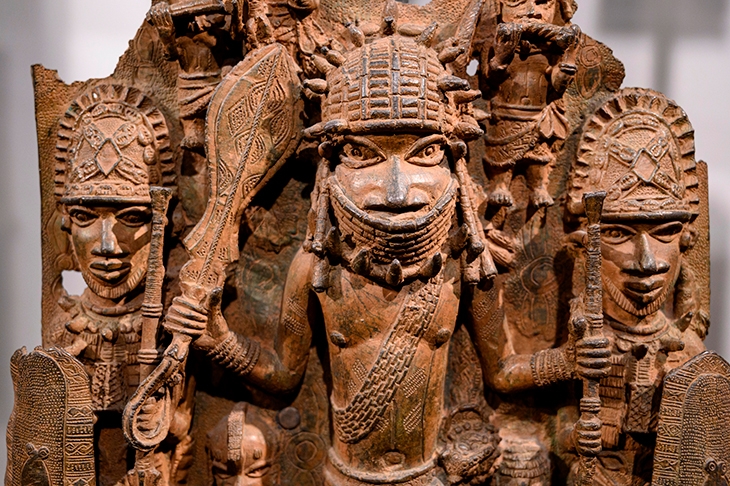
One of the things Benin is most famous for is its bronze sculptures and the 5,000 artefacts and treasures that were stolen by the British in 1897.
Benin has a long history in the art of bronze casting and Oba Oguola founded the Royal Guild of Bronze Casters in the 1200s. Although known for the bronze figures, there are many artefacts from Benin featuring brass casting and figures made from terracotta. Having your image cast in bronze was a privilege received only for the King and the Queen Mother.
Queen Idia

Probably the most famous of these bronze sculptures is the head of Queen Idia.
Queen Idia was the mother of Oba Esigie who, as a second-born son, technically held little to no rights to the throne. However, during their father’s reign, Esigie’s older brother Arhuaran was educated in Portugal and spent little time in Benin. At the time of succession, Arhuaran wasn’t as familiar with Benin culture or people, had few ties and even less who were loyal to him, so Esigie challenged him for the throne. As civil war broke out, Idia took up arms and defended Benin against neighboring armies seeking to take advantage of the kingdom’s unrest. When Esigie finally took the throne he honored his mother by creating the title of Queen Mother. Formerly, once sons took up the throne, mothers of the Oba were to return to their separate quarters and never see their son again. But Esigie loved and respected his mother so much that he created a title and role giving her real authority and power as an advisor to the king.
He also commissioned a bronze head to be cast for her, the first of a woman. Following this precedent, all future Queen Mothers received the same privileges, authority, and honor.
The Guild of Bronze Casters is now a World Heritage site and you can visit and experience this intricate skill that has been passed down through the centuries. Unfortunately, many of the looted artefacts remain in exile and have not yet been returned home, including the indomitable Queen Idia.
#SendHomeIdia.

